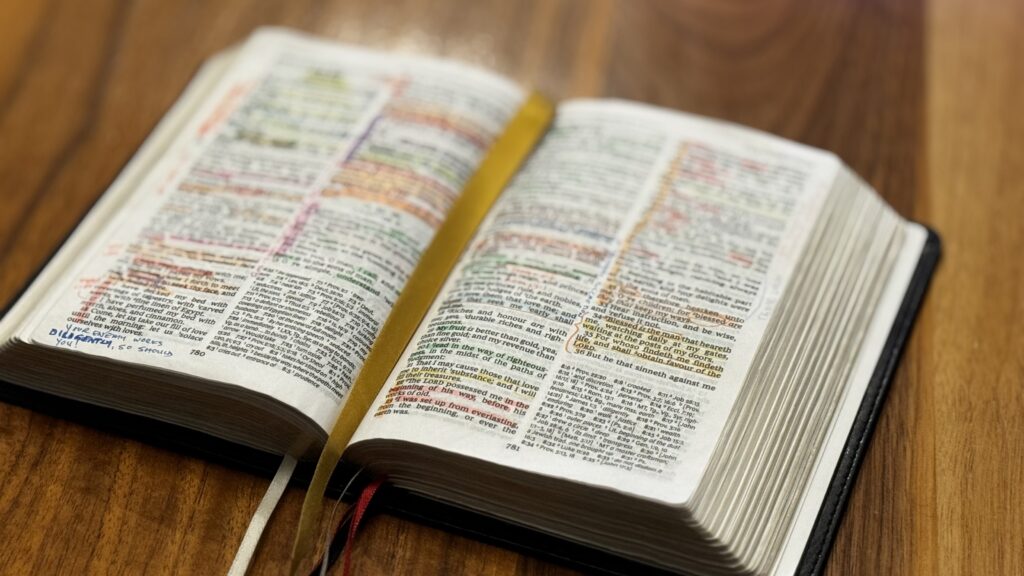
The Bible & Translations
There is some truth in the age-old adage that the best Bible translation is the one that you will read. Often when someone asks which translation is the best one, the intent behind the question is to find the “most accurate” or “closest literal meaning” to the original Hebrew, Greek or Aramaic texts. This answer doesn’t exactly satisfy the person’s question very well, but there is still some truth to the answer.

The scripture is alive… (Jn 1:1)
…and sharper than any two-edged sword (Heb 4:12) and it will go out and accomplish all that the Lord pleases, it will not return unto Him void (Is 55:11). If we truly believe that – which we absolutely do – then how hard is it to also believe that the Bible is inspired by God and sufficient for doctrine, reproof, correction and instruction in righteousness (2 Tim 3:16-17)?
Have you considered the impossibility (Lk 18:27) of scripture? It may not seem far-fetched to say that the 66 books of the Bible (that’s 31,102 verses in 1,189 chapters) have over 63,000 cross references until we consider that these 66 books were written by inspiration of the Holy Spirit (2 Tim 3:16) by 40 different authors over a 1,500-year time span on three different continents in three different languages. There are approximately a combined ~35,000 manuscripts, fragments, or scrolls that comprise the various writings of the Holy Book, making it by far the most documented ancient text that we have.
Consider other well-known ancient texts
Yet despite such documentation, it is still challenged as being manipulated, changed, or altered. Compared to the vastness of ~35,000 pieces of evidence, other ancient texts that go unchallenged by scholars pale in comparison in their numbers of manuscript evidence: Homer’s Iliad and The Odyssey, for example, boast a fraction of such numbers at roughly 2,900 pieces of manuscript evidence combined. While the gap between the original composition of Iliad (9th or 8th century BCE) and the earliest of the 1,900 copies (around 400 years later) is larger than that of the New Testament; the sheer number of surviving manuscripts is scholastically significant for an ancient text. Julius Caesar’s The Gallic Wars offers 10 remaining manuscripts, with its earliest dating to approximately 1,000 years after the original. There are roughly seven manuscripts left of Plato’s essay, with the earliest dating at about 1,300 years after its original. The number of manuscripts is what supports scholarly claims of manuscript authenticity, so the higher the number matching and corroborating manuscripts, the more accurate the authenticity of the manuscript in question.

How our Bible is translated
Authenticity of the translation you read
Understanding the scholarly authenticity of the Bible helps us to understand a little bit better how choosing a “correct” translation might not seem as important as one might think. It certainly is important indeed, and given that there were some pitfalls and versioning avoided, if the last copy of the Bible that exists on Earth is different than that of which I’ve preferred reading all my life, I can rest assured that the Lord will still speak to me (Is 55:11) and move in my life (Ps 119:133) through that down-looked-upon version. What is important is having faith in the word of God, and that it is inerrant and all sufficient (2 Tim 3:16, Heb 4:12) as God’s word – that the “correct” version to study and read from is more about whether it will be understood and consumed or sit on a shelf and collect dust.
Translation over translation over translation…?
Keep in mind that when understanding the process undertaken to create a translation, each translation is taken directly from the original manuscripts, NOT from other previously published translations. In other words, the original Hebrew/Greek/Aramaic was translated into the King James Version (KJV).
Also, the original Hebrew/Greek/Aramaic was translated into the New King James Version (NKJV). The NKJV is NOT a translation or alteration from the KJV. Each translation of scripture – whether it be KJV, NKJV, NIV, NASB95, NASB20, ESV, LSB, etc. – is derived “first-generation” from the original manuscripts.
Consuming the bread of life – the Word of God
While there are several different ways to consume the Bible, let us consider just two:
- Devotional reading; and
- Academic study.
Devotional reading focuses on personal, spiritual application and reflection, aiming to connect personally with God and find encouragement, edification, and growth. Academic study focuses on objective interpretation, historical, and cultural context, and a comprehensive understanding of the text, known as hermeneutics. Further to this, devotional reading is also for personal spiritual nourishment and applying the text to one’s life, whereas academic study involves tools like commentaries, concordances, dictionaries, original languages, and historical research to understand the text’s original meaning. The depth and richness to whatever end one spends in the word is priceless and blessed (Ps 119:10-16) when approached from a Biblical frame of mind with the Holy Spirit (Mt 10:19; Mk 13:11) to enlighten your path (Ps 119:105). Regardless of whether a reader is reading for devotion or for academia, enlightenment comes only through the enabling of the Holy Spirit (Eph 1:18, Rom 3:10-18). As we pray without ceasing (1 Thes 5:17), we must seek the Lord’s wisdom to discern His word (Prov 4:7, Ja 1:5) and His promise is that He will not forsake those who seek after Him (Ps 9:10).