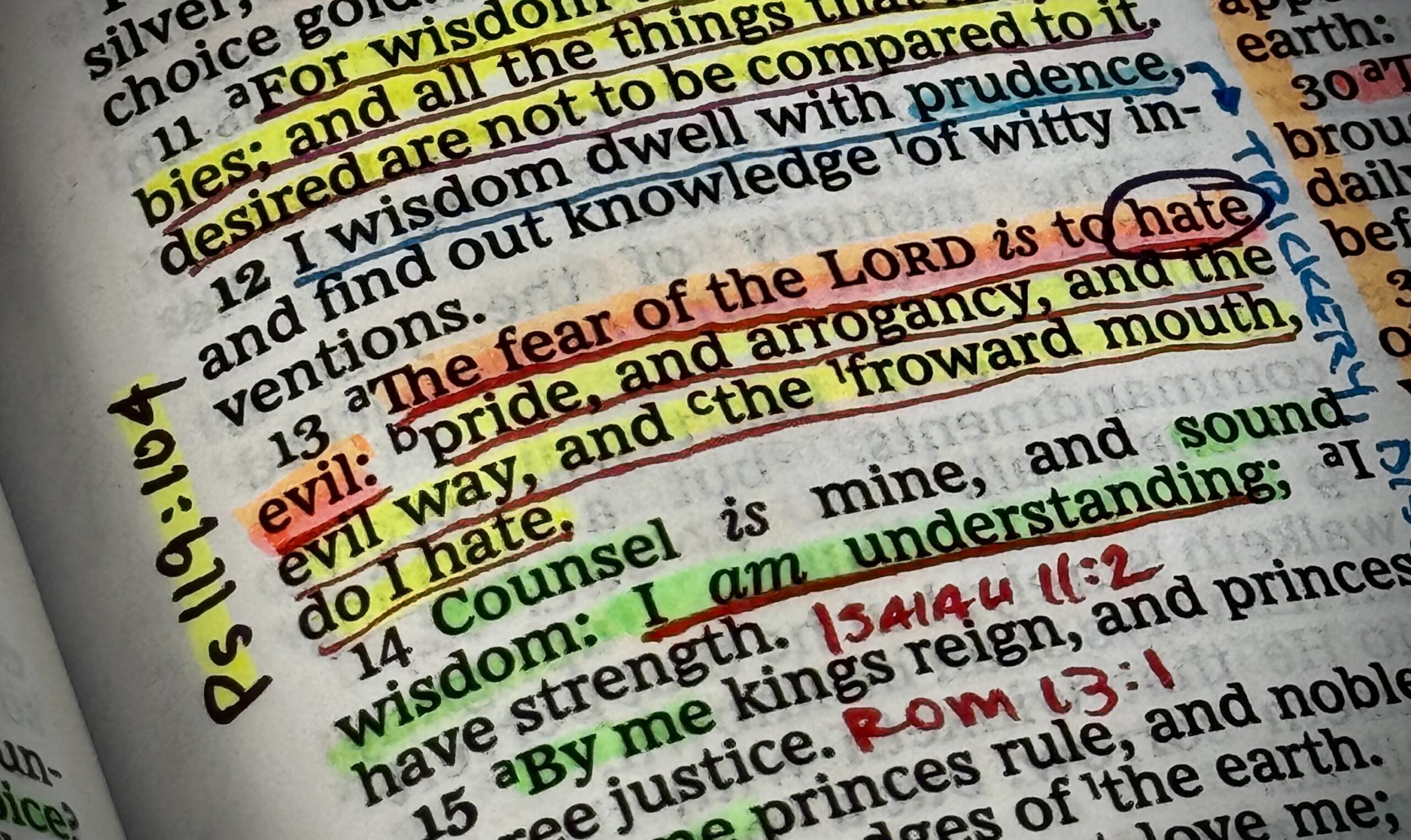
“The fear of the LORD is to hate evil: pride, and arrogance, and the evil way, and the froward mouth, do I hate.” Proverbs 8:13
The phrase, “fear the LORD” appears 30 times in the Bible, mostly as commands, some in the context of a question (such as in Jeremiah 26:19). We often ask ourselves what it means to fear the LORD. How do we fear the LORD if it seems at first glance contradictory to have fear; 2 Timothy 1:7 says that God has not given us the spirit of fear, but a spirit of power, love and a sound mind. How can we fear the LORD if we aren’t given a spirit of fear? The fact is that fear is a part of life, and what we fear is what matters. The context of 2 Timothy 1:7 is not to be fearless, but it is in regard to not fearing the world and their response to the testimony of our LORD. Paul exhorts young Timothy to not be ashamed of that testimony and to be a partaker of the afflictions of the gospel according to the power of God. In Matthew 10:28, Jesus also tells us not to fear those which kill the body and not the soul, “but rather fear him which is able to destroy both soul and body in hell.” Understanding the emotion of fear and how to navigate it is what the Bible tells us to do – not to avoid fear altogether.
It is said that the Bible tells us 365 times to “fear not”, or “be not afraid”, or some other variation of that sort – one for every day of the year! While that claim may be challenged by skeptics, being used to defraud Christians looking to spread some encouragement, it still stands that scripture teaches us what to fear and what not to fear. Proverbs 8:13 clearly tells us what it means to fear the LORD: Hate evil, hate pride, hate arrogance, hate the evil way, hate the froward mouth. The Bible tells us more of what the LORD hates, giving us further clarification as to how we can fear Him: Proverbs 6:16-19 explains the following: “These six things doth the LORD hate: yea, seven are an abomination unto him: 17 A proud look, a lying tongue, and hands that shed innocent blood, 18 An heart that deviseth wicked imaginations, feet that be swift in running to mischief, 19 A false witness that speaketh lies, and he that soweth discord among brethren.”
Psalm 119:97-104 is perhaps one of my most treasured understandings about how to rightly fear the LORD. The author, widely attributed to King David but without certain evidence thereof, writes 22 stanzas – one for each of the 22 Hebrew letters of their alphabet, and it is in the letter of MEM that it is written about how keeping God’s law and leaning in toward Him is what leads to the same conclusion that Proverbs 8:13 delivers: Seven verses leading to the 8th – to hate every false way.
97 O how love I thy law! it is my meditation all the day.
98 Thou through thy commandments hast made me wiser than mine enemies: for they are ever with me.
99 I have more understanding than all my teachers: for thy testimonies are my meditation.
100 I understand more than the ancients, because I keep thy precepts.
101 I have refrained my feet from every evil way, that I might keep thy word.
102 I have not departed from thy judgments: for thou hast taught me.
103 How sweet are thy words unto my taste! yea, sweeter than honey to my mouth!
104 Through thy precepts I get understanding: therefore I hate every false way.
Hate is a very strong word, and my mom raised me to use that word sparingly, knowing that the Bible uses it in the harshest of realities. Her voice echoes in my memory, “be careful about what you say you hate. Hate is a very strong word.” Proverbs usage of hate in chapter 8 verse 13 is found in the Strong’s Concordance as:
H8130: שָׂנֵא śānē’ saw-nay’; a primitive root; to hate (personally): – enemy, for, (be) hate(-ful, -r), odious, x utterly.
To paraphrase in my own words: To personally hate, or be hateful of, or a hater of; such as toward an enemy or foe.
Being that we’re in a spiritual battle (Ephesians 6:12, 2 Timothy 2:3-4), on a battlefield for the souls of the lost (Mark 16:15, Proverbs 11:30), our enemy must be hated, which drives us to remain focused and uncompromised in our mission. Who is our enemy? Our enemy is the enemy of the LORD God: Evil, pride, arrogance, evil ways, froward mouths, a proud look, a lying tongue, shedding innocent blood, wicked imaginations and the hearts that devises them, mischief and the feet that run to it, false witnesses, discord, and the one that sows it among the brethren, and cowards – our enemy is comfort, convenience, and consumerism, which leads to compromise and cowardice. When we learn to hate what He hates, we will be more effective on the battlefield. How do we hate this enemy? Be uncomfortable and sacrificial (Romans 12:1, Matthew 20:16), do not be conformed to this culture, this world, but be transformed by the renewing of your mind (Romans 12:2), and having knowledge and knowing your God, being strong and doing exploits (Daniel 11:32, Hosea 4:6). We are not called to merely sit by and pray for Jesus to do all the work, acting as victims, weak, and uncertain. Jesus commanded us to GO and PREACH (Matthew 28:18-20), He said to DO things. He’s called us to be active participants and affect the battle space for His glory (Isaiah 6:8).