Category: Teachings

  • The fear of the LORD is…

    The fear of the LORD is…

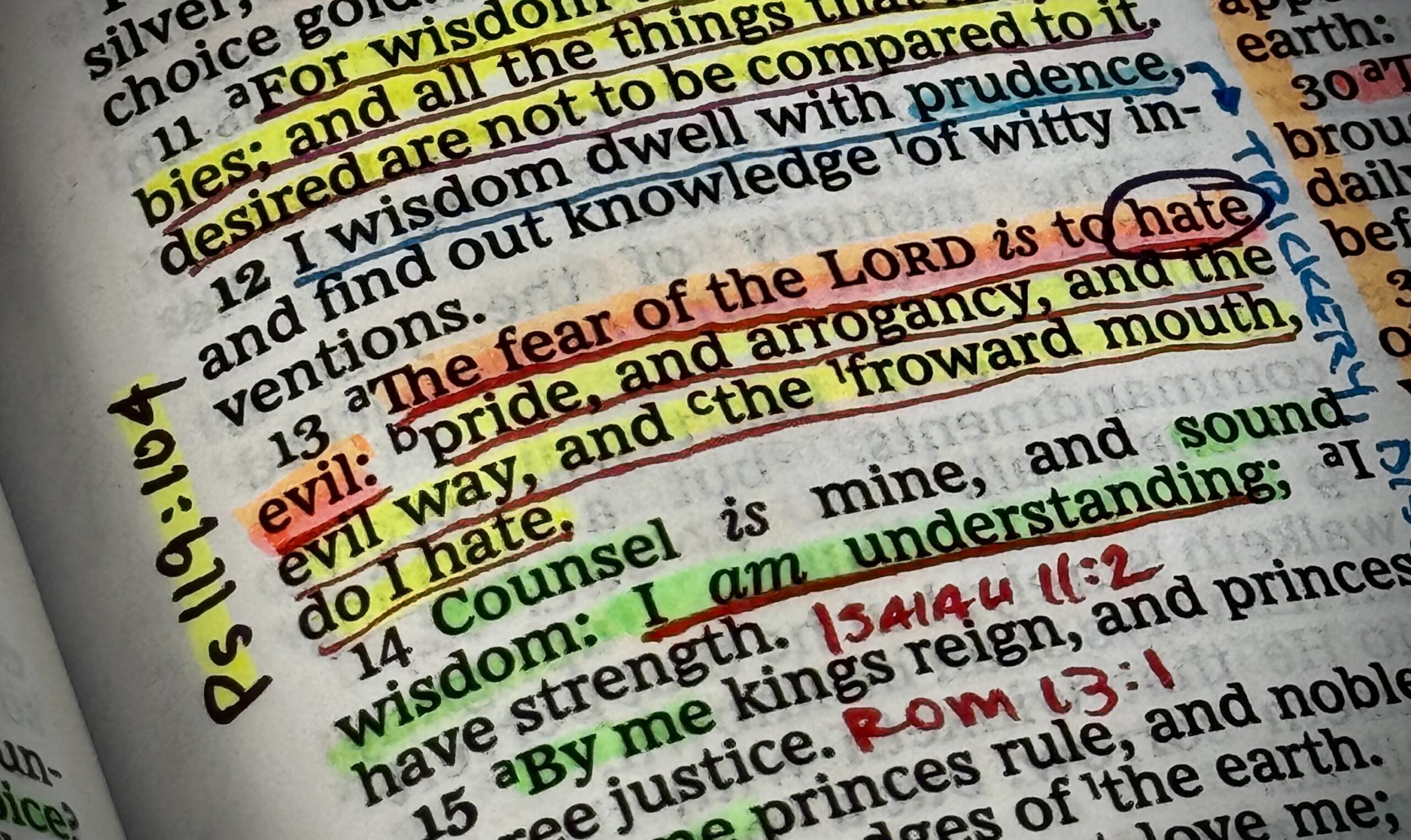
    “The fear of the LORD is to hate evil: pride, and arrogance, and the evil way, and the froward mouth, do I hate.” Proverbs 8:13

    The phrase, “fear the LORD” appears 30 times in the Bible, mostly as commands, some in the context of a question (such as in Jeremiah 26:19). We often ask ourselves what it means to fear the LORD. How do we fear the LORD if it seems at first glance contradictory to have fear; 2 Timothy 1:7 says that God has not given us the spirit of fear, but a spirit of power, love and a sound mind. How can we fear the LORD if we aren’t given a spirit of fear? The fact is that fear is a part of life, and what we fear is what matters. The context of 2 Timothy 1:7 is not to be fearless, but it is in regard to not fearing the world and their response to the testimony of our LORD. Paul exhorts young Timothy to not be ashamed of that testimony and to be a partaker of the afflictions of the gospel according to the power of God. In Matthew 10:28, Jesus also tells us not to fear those which kill the body and not the soul, “but rather fear him which is able to destroy both soul and body in hell.” Understanding the emotion of fear and how to navigate it is what the Bible tells us to do – not to avoid fear altogether. 

    It is said that the Bible tells us 365 times to “fear not”, or “be not afraid”, or some other variation of that sort – one for every day of the year! While that claim may be challenged by skeptics, being used to defraud Christians looking to spread some encouragement, it still stands that scripture teaches us what to fear and what not to fear. Proverbs 8:13 clearly tells us what it means to fear the LORD: Hate evil, hate pride, hate arrogance, hate the evil way, hate the froward mouth. The Bible tells us more of what the LORD hates, giving us further clarification as to how we can fear Him: Proverbs 6:16-19 explains the following: “These six things doth the LORD hate: yea, seven are an abomination unto him: 17 A proud look, a lying tongue, and hands that shed innocent blood, 18 An heart that deviseth wicked imaginations, feet that be swift in running to mischief, 19 A false witness that speaketh lies, and he that soweth discord among brethren.” 

    Psalm 119:97-104 is perhaps one of my most treasured understandings about how to rightly fear the LORD. The author, widely attributed to King David but without certain evidence thereof, writes 22 stanzas – one for each of the 22 Hebrew letters of their alphabet, and it is in the letter of MEM that it is written about how keeping God’s law and leaning in toward Him is what leads to the same conclusion that Proverbs 8:13 delivers: Seven verses leading to the 8th – to hate every false way.

    97 O how love I thy law! it is my meditation all the day. 

    98 Thou through thy commandments hast made me wiser than mine enemies: for they are ever with me. 

    99 I have more understanding than all my teachers: for thy testimonies are my meditation. 

    100 I understand more than the ancients, because I keep thy precepts. 

    101 I have refrained my feet from every evil way, that I might keep thy word. 

    102 I have not departed from thy judgments: for thou hast taught me. 

    103 How sweet are thy words unto my taste! yea, sweeter than honey to my mouth! 

    104 Through thy precepts I get understanding: therefore I hate every false way.

    Hate is a very strong word, and my mom raised me to use that word sparingly, knowing that the Bible uses it in the harshest of realities. Her voice echoes in my memory, “be careful about what you say you hate. Hate is a very strong word.” Proverbs usage of hate in chapter 8 verse 13 is found in the Strong’s Concordance as:

    H8130: שָׂנֵא śānē’ saw-nay’; a primitive root; to hate (personally): – enemy, for, (be) hate(-ful, -r), odious, x utterly.

    To paraphrase in my own words: To personally hate, or be hateful of, or a hater of; such as toward an enemy or foe. 

    Being that we’re in a spiritual battle (Ephesians 6:12, 2 Timothy 2:3-4), on a battlefield for the souls of the lost (Mark 16:15, Proverbs 11:30), our enemy must be hated, which drives us to remain focused and uncompromised in our mission. Who is our enemy? Our enemy is the enemy of the LORD God: Evil, pride, arrogance, evil ways, froward mouths, a proud look, a lying tongue, shedding innocent blood, wicked imaginations and the hearts that devises them, mischief and the feet that run to it, false witnesses, discord, and the one that sows it among the brethren, and cowards – our enemy is comfort, convenience, and consumerism, which leads to compromise and cowardice. When we learn to hate what He hates, we will be more effective on the battlefield. How do we hate this enemy? Be uncomfortable and sacrificial (Romans 12:1, Matthew 20:16), do not be conformed to this culture, this world, but be transformed by the renewing of your mind (Romans 12:2), and having knowledge and knowing your God, being strong and doing exploits (Daniel 11:32, Hosea 4:6). We are not called to merely sit by and pray for Jesus to do all the work, acting as victims, weak, and uncertain. Jesus commanded us to GO and PREACH (Matthew 28:18-20), He said to DO things. He’s called us to be active participants and affect the battle space for His glory (Isaiah 6:8). 
  • Dads, provoke not your children to wrath

    Dads, provoke not your children to wrath

    Ephesians 6:4

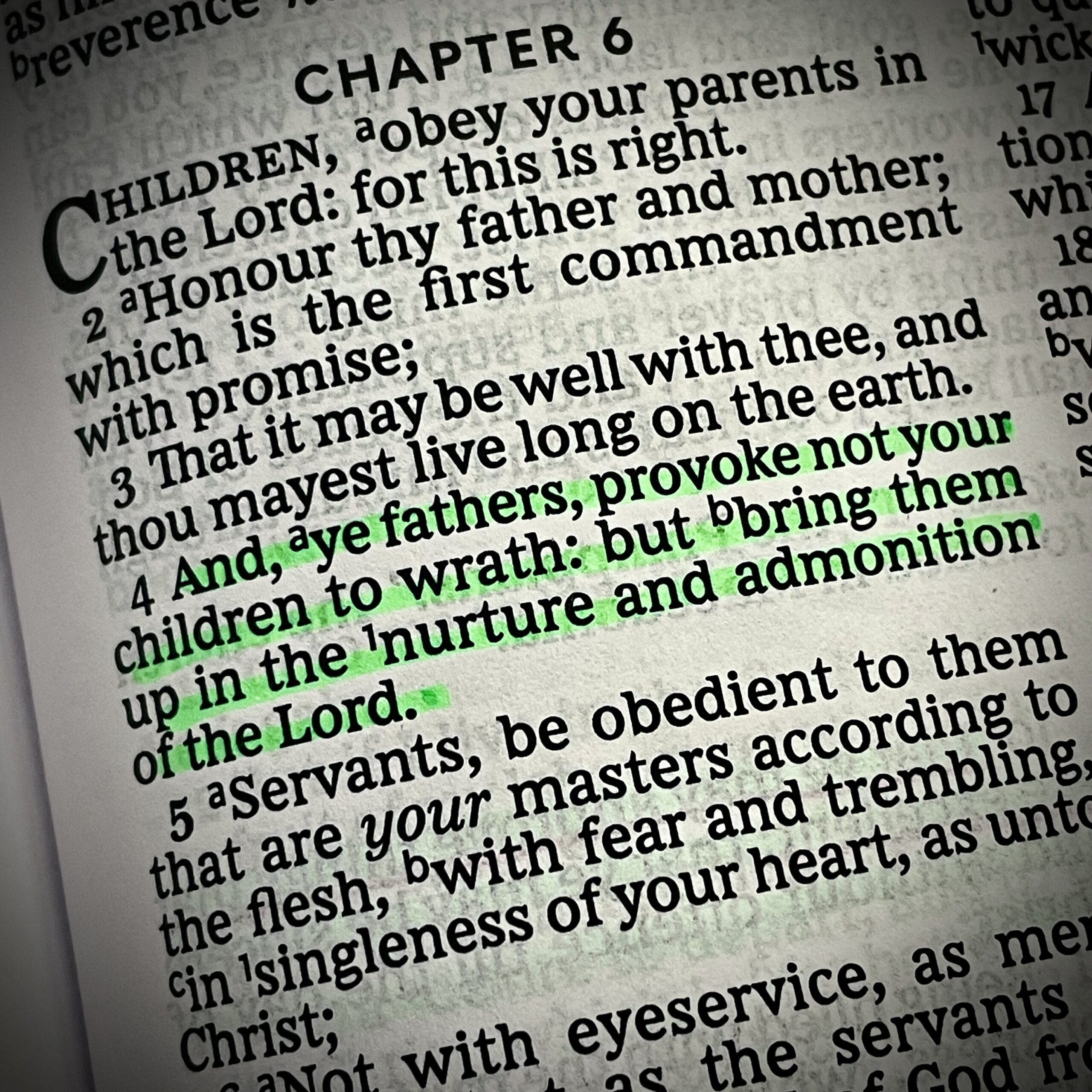
    “And, ye fathers, provoke not your children to wrath: but bring them up in the nurture and admonition of the Lord.”

    This is a two-fold commandment: 1. Do not do this: “provoke not your children to wrath.” 2. Do this: “bring them up in the nurture and admonition of the Lord.”

    Provoke not your children to wrath: There are two ways to entreat with your children, Dads. Through gentleness or through harshness. The choice is ours and often times, we fall to the side of culture and not Christ and think how we need to be tough of them, when in reality, they need our love, grace and gentleness.

    Bring them up in the nurture and admonition of the Lord: Often times, we dads think that nurturing is for the mother to do. This couldn’t be further from the Truth – as you read in Ephesians 6, WE dads have a unique calling to nurture our children. We also are given the unique calling to do so with admonition.

    Remember, it was the compassionate father who ran to the prodigal son upon his return. How can we work toward being nurturing, loving, and godly fathers toward our children?

    Passages to read:

    Luke 15:11-32, The Prodigal Son.

    Psalm 127, a quiver full of arrows.

    Mark 10:13-16, Forbid not the little children.

    Matthew 18:6, The Father’s great love of children.

  • Be careful what you call heresy

    In simple terms, heresy is a belief or opinion that goes against the established and official doctrines of a particular religion. Anymore these days, it is thrown around with ease because someone likes Culver’s hamburgers over McDonald’s. It involves rejecting core tenets and is often seen as a serious error, though it can also refer to any belief that is contrary to established theory. The term originally meant “choice” or “sect” but came to be used by the church to mean a division or departure from its official beliefs. 

    It easy to see how this evolved from just an acknowledgement of differences in choice into a departure from the faith when we consider Paul’s orders in Galatians:

    Galatians 1:6-10 I marvel that ye are so soon removed from him that called you into the grace of Christ unto another gospel: 7 Which is not another; but there be some that trouble you, and would pervert the gospel of Christ. 8 But though we, or an angel from heaven, preach any other gospel unto you than that which we have preached unto you, let him be accursed. 9 As we said before, so say I now again, If any [man] preach any other gospel unto you than that ye have received, let him be accursed. 10 For do I now persuade men, or God? or do I seek to please men? for if I yet pleased men, I should not be the servant of Christ.

    With using words such as “pervert” (G3344: to transmute or corrupt) and “accursed” (G331: anathema, meaning without hope of being redeemed, excommunicated), how could one think it be so light a thing to simply have differing opinions on what the scriptures say? As if it weren’t already serious enough for him to say once in verse 8 to let them be accursed, but he doubles down in verse 9, emphasizing the seriousness with repetition. 

    Certain theologians and scholars have gone on the record saying that the only heresy that truly exists is that of preterism, whether it be partial preterism or full (also known as hyper) preterism. Without getting to deep off topic, preterism is simple an eschatological view of when prophecies were supposedly fulfilled. However, given the scope of definition of the word heresy, I would peradventure say that the only true doctrine that could be construed as heretical would be a departing from the truth of the salvific doctrines. As Paul so pointedly stated, “But though we, or an angel from heaven, preach ANY OTHER GOSPEL unto you than that which we have preached unto you, let him be accursed.”

    So, what is a salvific doctrine? Salvific is defined as leading to salvation: “the salvific power of the Lord”. This is the very message of the gospel of which Paul speaks of in the above passage from Galatians. Paul delivers this gospel message perhaps most prominently in the first letter to the Corinthians and to the Romans when he says the following: 

    1 Corinthians 15:1-4 Moreover, brethren, I declare unto you the gospel which I preached unto you, which also ye have received, and wherein ye stand; 2 By which also ye are saved, if ye keep in memory what I preached unto you, unless ye have believed in vain. 3 For I delivered unto you first of all that which I also received, how that Christ died for our sins according to the scriptures; 4 And that he was buried, and that he rose again the third day according to the scriptures:

    And in Romans, by which some call it the “Golden Road to Rome”:

    Romans 3:10-12 As it is written, There is none righteous, no, not one: 11 There is none that understandeth, there is none that seeketh after God. 12 They are all gone out of the way, they are together become unprofitable; there is none that doeth good, no, not one.

    Romans 3:23 For all have sinned, and come short of the glory of God;

    Romans 5:12 Wherefore, as by one man sin entered into the world, and death by sin; and so death passed upon all men, for that all have sinned:

    Romans 6:23 For the wages of sin is death; but the gift of God is eternal life through Jesus Christ our Lord.

    Romans 5:8 But God commandeth his love toward us, in that, while we were yet sinners, Christ died for us.

    Romans 10:9-10, 13 That if thou shalt confess with thy mouth the Lord Jesus, and shalt believe in thine heart that God hath raised him from the dead, thou shalt be saved. 10 For with the heart man believeth unto righteousness; and with the mouth confession is made unto salvation. 13 For whosoever shall call upon the name of the Lord shall be saved.

    If you have read these passages and your eyes have been newly enlightened to their meaning, please reach out and let us know! We would love to discuss further what this means for you and where to go from here.

  • Did you know (Psalm 118)?

    • Psalm 118 is the middle chapter of the entire Bible?
    • Psalm 117, before Psalm 118 is the shortest chapter in the Bible?
    • Psalm 119, after Palm 118 is the longest chapter in the Bible?
    • The Bible has 594 chapters before Psalm 118 and 594 chapters after Psalm 118?
    • If you add up all the chapters except Psalm118, you get a total of 1188 chapters.
    • 1188 or Psalm 118 verse 8 is the middle verse of the entire Bible?

    Should the central verse not have an important message? “It is better to trust and take refuge in the Lord than to put confidence in man.”